

Ask a foreign visitor who has spent a week in Shanghai to describe China and you will hear about metro lines, delivery scooters and skyscrapers. Ask them to describe the village where their driver’s parents live, and the answer often collapses into a few words: farming, poverty, old people. Both pictures are drawn from real places. Neither describes the country, because roughly 460 million people still live in rural areas and their circumstances range from wealthy industrial villages on the Pearl River Delta to depopulated mountain hamlets where the nearest secondary school is an hour away.
The gap between city and countryside is one of the most consequential facts about modern China, and one of the easiest to caricature. The useful questions are narrower: how large is the income difference, what has changed in rural services and infrastructure, who is being left behind, and is the distance actually shrinking?
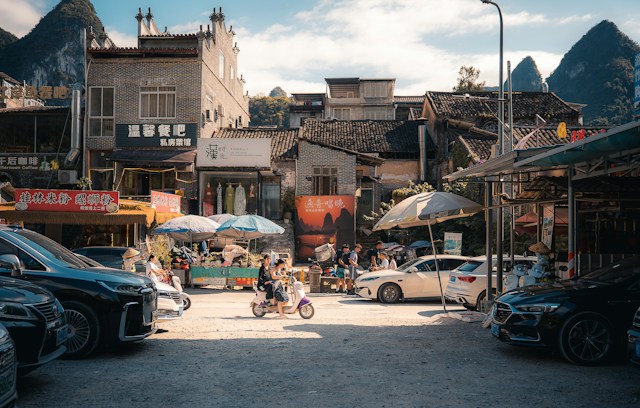
What the income numbers show
In 2025, China’s per-capita disposable income was about 56,500 yuan for urban residents and 24,456 yuan for rural residents, according to official figures – an urban-to-rural ratio of roughly 2.31 to 1, down from 2.56 to 1 in 2020. That ratio is the most quoted statistic about the divide, and it deserves careful reading.
Two caveats matter. The ratio has been falling for more than a decade but remains well above its mid-1980s low point, when rural incomes briefly grew faster than urban ones after the household responsibility system was introduced. And the rural figure averages a very heterogeneous population: farm households, villages with their own factories, and families whose main income arrives as remittances from relatives working in cities. A village with an industrial park at its edge and a village without one have more in common statistically than socially.
Purchasing power narrows the gap somewhat. Housing, vegetables and local services cost far less in a rural county than in a first-tier city, so a 2.3-to-1 nominal ratio does not mean a 2.3-to-1 difference in living standards. It does produce a persistent difference in what households can save, borrow, and spend on schooling and healthcare.
Infrastructure has moved faster than income
The most visible rural change of the past fifteen years is physical. Paved roads reach nearly every administrative village, electricity is close to universal, and mobile broadband covers most of the country. Village courier stations – often a shelf in a small shop – made e-commerce viable in places with no bank branch. A farmer can now sell produce directly to urban buyers, and a household can order appliances that once required a trip to the county seat.
This matters for how the divide is experienced. A rural teenager today may have a smartphone, a delivery network and access to livestream commerce; their grandparents grew up with none of it. Meanwhile the income gap that shapes housing quality, medical options and school choice has narrowed only gradually. The two trends run at different speeds, and conflating them is where much outside commentary goes wrong.
The hukou line
The legal architecture of the divide is the household registration system, or hukou, inherited from the 1950s. A person’s registration determines access to public schooling, subsidized healthcare and some housing rights. Rural residents who migrate to cities – hundreds of millions have – can work there, but often cannot enroll children in local public schools on equal terms, and their pension entitlements differ from those of registered urban residents.
Reforms since the 2010s have lowered the barrier in small and mid-sized cities and, in some places, allowed residency based on regular residence rather than employment. Large cities remain restrictive. For a reader wondering why a delivery rider in Beijing plans to go home to his county at forty, the hukou is usually part of the answer.
Who is left in the villages
Migration has reshaped the demographics of rural China. Younger adults cluster in cities, and many villages now hold two groups: the elderly and children raised by grandparents. The broader numbers are stark. By the end of 2024, China’s population aged 60 and over had reached 310.31 million, or 22 percent of the total, and a large share of that group lives in rural areas with thinner health services. Separately, several hundred million people live outside their registered locality, which is why “floating population” appears in almost every demographic analysis.
These are not interchangeable problems. An elderly person in a coastal industrial village may live within reach of a county hospital and a job for a grandchild. An elderly person on a terraced hillside in Guizhou may face a two-hour trip for dialysis. Provincial averages hide enormous differences, and any account that treats “the countryside” as one place will be wrong about most of it.
The new rural economy
Rural income is no longer mainly agricultural. Wages from local enterprises and migrant work, plus transfers such as agricultural subsidies and, since the 2010s, rural pensions, account for a large share of household income. E-commerce added a newer source: livestream selling of fruit, tea, handicrafts and clothing from county-level production bases, which has produced genuine successes alongside a good deal of hype.
County-level urbanization is the policy response most often cited by officials – concentrating services and jobs in small cities so people need not move to megacities. Whether it works depends on local industry. Places with manufacturing clusters have retained population; places without them have kept emptying.
Is the gap narrowing?
The honest answer: on some measures yes, on others not clearly. The income ratio has narrowed since around 2010, poverty against international lines has fallen sharply, and infrastructure and connectivity have improved across most rural counties. Rural pension coverage expanded in the 2010s, though benefit levels remain low relative to urban pensions.
Against that, the gap in public service quality – hospital capacity, teacher qualifications, elder care – is widely described by Chinese researchers as persistent, and a shrinking rural working-age population makes services harder to fund. Property values, household wealth and access to credit favor cities by a much wider margin than income alone suggests.
A single framing may help. Rural China is not the opposite of urban China. It is the same country under different constraints: fewer jobs per square kilometer, thinner services, cheaper housing, and a welfare system that historically assumed people would stay put. That assumption has been breaking down for forty years. The resulting mix of improvement and inequality is the actual story.
Sources: gov.cn / Xinhua on 2025 urban and rural per-capita disposable income (https://english.www.gov.cn/archive/statistics/202602/04/content_WS6982fecfc6d00ca5f9a08e97.html); World Bank World Development Indicators, urban population share, China (https://api.worldbank.org/v2/country/CHN/indicator/SP.URB.TOTL.IN.ZS); UNDP China on the population aged 60 and over at end-2024 (https://www.undp.org/china/publications/measurement-study-multidimensional-vulnerabilities-elderly-population-china); China Daily on National Bureau of Statistics ageing data (https://epaper.chinadaily.com.cn/a/202509/16/WS68c8bb44a310bb2da0974066.html). Verified 1 November 2026.