
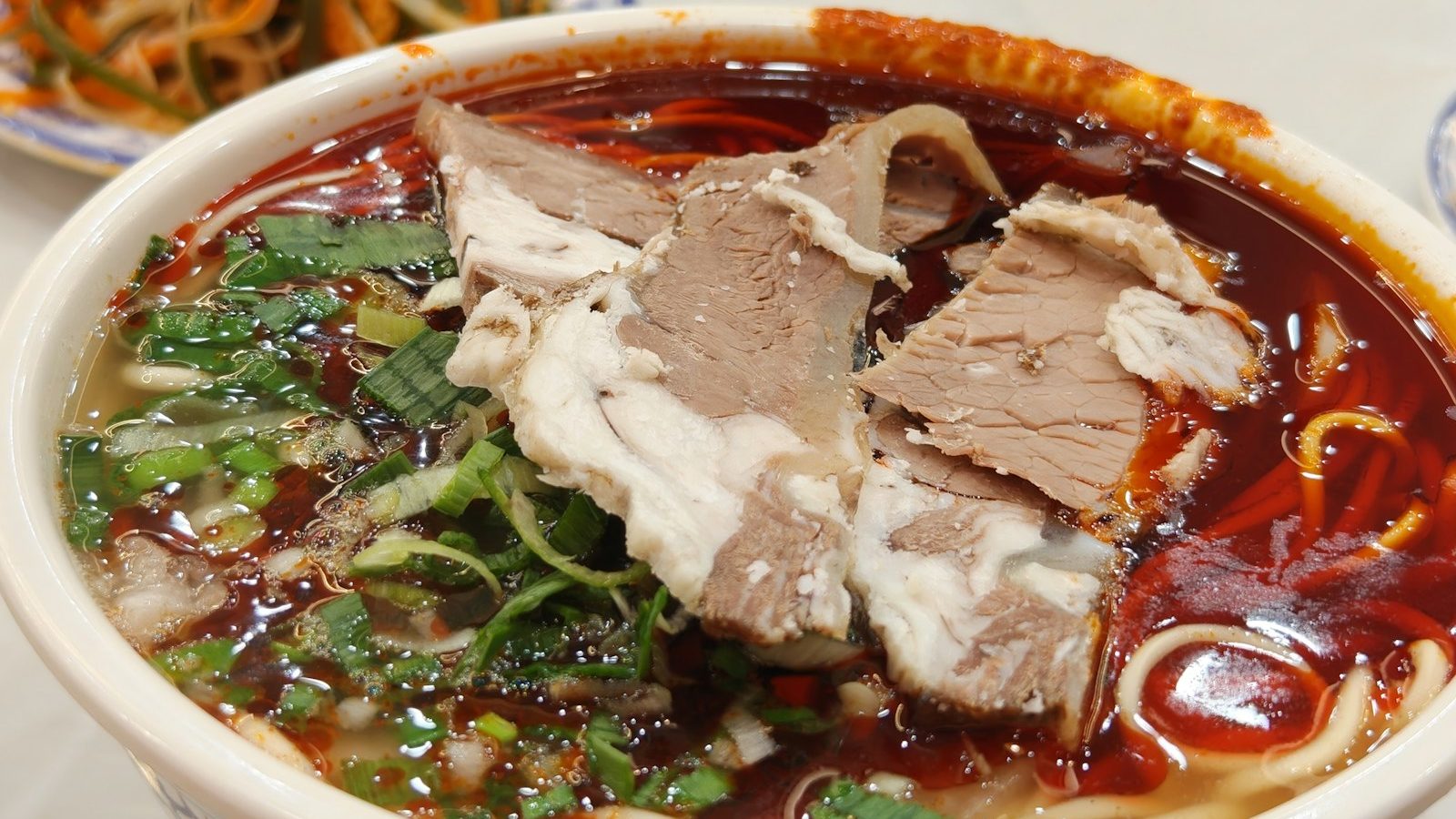
“Chinese noodles” is one of the most convenient phrases in English and one of the least accurate. It covers hand-stretched ropes of dough boiled in beef broth in Lanzhou, cold alkaline strands tossed in sesame paste in Wuhan, triangular shavings cut straight from a block of dough into boiling water in Shanxi, and thin egg noodles floating under a few shrimp wontons in Guangzhou. These dishes share a category name and almost nothing else: not the grain, not the chemistry, not the technique, not even the moment of the day people eat them.
This is not a ranking of the “ten great noodles of China.” Lists like that flatten exactly what makes the subject interesting. What follows is a map of the differences — the grain underneath the bowl, the way the noodle is formed, and the local logic of what goes on top.
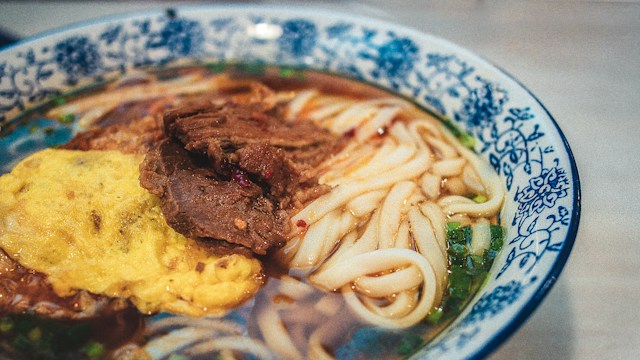
First question: wheat, rice, or something else?
The most basic split in Chinese cooking is the one between wheat and rice, and it roughly follows the Qinling Mountains and the Huai River, a line running near the 33rd parallel that separates the drier, colder north from the wetter, warmer south. North of it, wheat dominates and noodles and steamed buns are the daily staple. South of it, rice does.
Like most rules about food, this one explains a great deal and then trips over itself. Wuhan sits south of the line and eats noodles for breakfast. Chongqing, well south, has its own noodle culture with xiaomian. Guangzhou, firmly subtropical, is the home of wonton noodles. Meanwhile rice noodles — mifen and mixian — appear in the south as the rice counterpart of wheat noodles, and in Guilin and Yunnan they are the local breakfast of choice.
So the grain line shapes the default, not the menu. What travels across the line is not the ingredient but the idea: a cheap starch, quickly made, eaten by people who need to get to work.
How the noodle gets its shape
The second variable is technique, and it explains texture more than any recipe does. Wheat flour with enough gluten can be stretched, thrown, shaved, or cut; how you handle it decides whether a noodle is springy, chewy, slippery, or soft.
In Lanzhou, the dough is pulled. Hand-pulled noodles — lamian — are made by stretching and folding a single rope of dough repeatedly until it divides into dozens of strands, a process that takes minutes and a lot of practice. The Lanzhou technique, documented by China’s Intangible Cultural Heritage database, breaks the process into five steps: selecting ingredients, mixing the dough, resting it, working it into ropes, and pulling. The same base dough can produce noodles at different thicknesses and widths on request, from hair-fine to broad ribbon.
In Shanxi, the dough is cut. Daoxiaomian, knife-shaved noodles, starts with a firm, rounded block of dough held in one hand while a curved blade shaves strips straight off the surface and into boiling water. Each strip lands with a thick middle and thin edges, described in heritage records as leaf-shaped. Shanxi’s noodle repertoire is unusually deep — the province’s own figures count eight noodle techniques on the national intangible-heritage list — but knife-shaving is the version that traveled best, because the spectacle of it travels with the taste.
In Wuhan, the noodle is pre-cooked, then finished on demand. Hot dry noodles — reganmian — use an alkaline wheat noodle that is boiled, drained, tossed with oil, and spread out to cool before it ever reaches a customer. At the stall, a portion is dunked in boiling water for a few seconds, drained, and dressed. That process, rather than a secret ingredient, is what gives the bowl its name.
Each method solves a practical problem. Pulling makes noodles that cook in seconds. Shaving makes thick, chewy pieces that hold up in heavy sauce. Pre-cooking and oiling makes a breakfast that can be served to a queue of commuters in under a minute.
Alkaline water: the invisible ingredient
Many southern and central Chinese noodles — wonton noodles, Wuhan’s hot dry noodles, some Sichuan noodles — are made with alkaline water rather than plain. The alkali raises the pH of the dough, which changes both color and texture: the noodles turn yellow and become firmer, more elastic, and slightly slippery. It also produces a faint mineral taste that regulars notice immediately and first-time visitors often cannot place.
This is why a Cantonese wonton noodle snaps when you bite it and a Lanzhou pulled noodle stretches instead. Neither is “better”; they are built for different sauces and different broths. An alkaline noodle holds up to a thick, oily dressing. A fresh pulled noodle is best when something hot and clear is poured over it.
The soup and the topping follow the local economy
The third difference is what goes into the bowl, and that tends to reflect what a region has.
Lanzhou beef noodles are built on the meeting of two worlds: wheat from the Loess Plateau to the north and beef from the grasslands of Gannan and Qinghai to the south. The heritage description is precise about the broth — beef and beef bones simmered for five to seven hours with cardamom, ginger, Sichuan pepper, nutmeg, clove, and white pepper — and about the finish: clear soup, white radish, red chili oil, green coriander and garlic sprouts, yellow noodles. The dish is a Hui Muslim tradition, associated with the restaurateur Ma Baozi in the early twentieth century, and it has since spread far beyond Gansu. Local heritage figures count more than 1,300 beef noodle shops in Lanzhou alone and over 40,000 nationwide.
Wuhan’s hot dry noodles are a dockside food. The dressing is sesame paste with sesame or rapeseed oil, soy sauce, chili oil, pickled vegetables, and scallions. It is heavy, fast, and eaten standing or walking, usually in the morning — part of the city’s guozao (“eat breakfast out”) habit, which treats breakfast as a public, street-level meal rather than a private one at home.
Sichuan’s dandanmian is the opposite of a soup dish. The name refers to the pole carried by street vendors who sold the noodles from baskets; the bowl is a small portion of noodles under a sauce of chili oil, sesame paste, preserved vegetable, minced pork, and Sichuan pepper. It is served dry, meant to be tossed and eaten quickly at a snack stall.
Guangzhou and Hong Kong’s wonton noodles are a Cantonese refinement: thin egg noodles with alkaline water, a clear broth of dried flounder and shrimp, and a handful of wontons filled mostly with shrimp. The bowl is traditionally small, partly so the noodles do not soften before they reach the table. It is snack food and comfort food at once, and its history in the region is long enough that the specific small-bowl style is often treated as a twentieth-century Cantonese development rather than an ancient one.
Why standardization is eating the differences — slowly
The dishes above are increasingly subject to the same forces as everything else in Chinese food: chains, franchises, and standards. Wuhan’s hot dry noodles got their first local production standard in 2024, a municipal regulation dividing the noodle into six production categories depending on how it is made and stored — from dried to fresh to semi-cooked to frozen — and setting requirements for factories that supply the city’s shops and supermarkets. The stated aim was food safety and consistency, not the abolition of the street bowl.
Whether that standardization preserves or dilutes the local version is a real question, and the answer is probably “both.” A factory-made semi-cooked noodle is far more consistent than a hand-tossed one, and far less interesting. Meanwhile Lanzhou beef noodles have become a global brand, with shops in more than 40 countries, and the technique is now taught as heritage rather than absorbed by apprenticeship alone.
What tends to survive is the thing that travels least well: the local hour, the local broth, the habit of eating it standing up outside a shop. A foreign reader who orders “Chinese noodles” will get a noodle. Which China they get depends on where they are.
Sources: China Intangible Cultural Heritage database, “Traditional noodle-making techniques (Lanzhou beef noodles)” (ihchina.cn/project_details/23794) and “Longxu lamian and daoxiaomian” (ihchina.cn/art/detail/id/14642); Wuhan Municipal Commerce Bureau report on the DB 4201/T 699-2024 hot dry noodle standard (sw.wuhan.gov.cn, Sept 2024); Wikipedia entries on alkaline noodles, knife-cut noodles, wonton noodles, and the Qinling–Huaihe Line. Policy and market figures verified 2 November 2026; original-taste and origin legends are treated as tradition, not established fact.