

A university graduate in China sends out dozens of applications for a job that would have been easy to get five years ago, takes a government exam along with three million other people, and then explains to relatives why she is not yet married. Reported separately abroad, these look like symptoms: youth burnout, exam fever, a demographic crisis. Side by side, we describe one structure. Young Chinese adults are navigating a labor market that expanded faster than the jobs that match out credentials, and a life script in which housing, marriage, and children are still priced as one package.
The graduate problem is a numbers problem
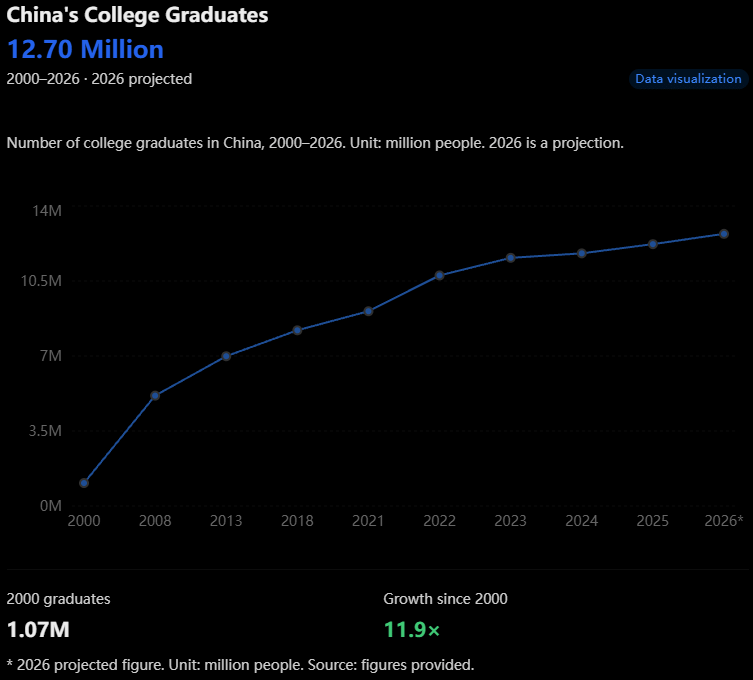
China’s Ministry of Education estimated that 12.7 million students would graduate from higher education in 2026, about 480,000 more than in 2025 (Xinhua, via the State Council Information Office). That is roughly the population of a mid-sized European country entering the job market every twelve months, year after year.
The unemployment figure most often quoted is the urban jobless rate for people aged 16 to 24. It rose to 18.9% in August 2026 from 17.9% in July, the highest reading in a year, according to National Bureau of Statistics data reported by Reuters. Since January 2024 that series has excluded students, which makes it a measure of young people actively looking for work rather than of all young people. The change matters. The previous series, which included students seeking jobs, hit a record 21.3% in June 2023; the statistics bureau then paused monthly releases for several months, saying it needed to improve the methodology, and resumed in early 2024 with the narrower definition.
Neither version tells you everything: a 16-year-old in a county town and a 24-year-old with a master’s degree are counted together, rural youth not registered as urban job seekers fall outside the sample, and the rate says nothing about job quality.
What the rate captures is a mismatch. China expanded university enrollment in the 2000s on the reasonable premise that a better-educated workforce would raise productivity, but the jobs that grew fastest were often in construction, manufacturing, delivery, and platform services, many of them not requiring a degree. The result is a cohort that is, on paper, the best educated in Chinese history and, in practice, competing for a smaller set of white-collar positions than its size implies. This is not unique to China; South Korea and India have variants of the same bottleneck. What is distinctive is the speed and scale.
Why so many people take the same exam
The national civil service exam, known as the guokao, has become the most visible expression of this squeeze. For the 2027 recruitment round, about 3.935 million people applied, 3.45 million passed the qualification review, and 35,691 positions were on offer, a ratio of roughly 97 applicants per place, according to figures reported from Xinhua. The 2026 round drew 3.718 million qualified applicants for around 38,100 posts; 2.83 million actually sat the written test.
It would be easy to read this as a cultural preference for officialdom. It is better read as a rational response to risk. Private-sector hiring has slowed, wages in some sectors have stagnated, and a government post offers predictable hours, a pension, and something close to immunity from layoffs. When the downside of a wrong bet is large and the upside is uncertain, a lottery with a stable prize attracts a crowd, even at odds of a hundred to one.
There are signs the state is adjusting to the same pressure. For the 2026 exam, the age ceiling was raised from 35 to 38 for most applicants, and to 43 for fresh master’s and doctoral graduates, the first change in decades. Officials linked the shift to plans for gradually raising the retirement age. The reform also quietly acknowledges something uncomfortable: the 35-year cutoff had turned a routine recruitment rule into a hard wall for anyone who changed careers in our thirties.
Housing, marriage, and the cost of the next step
Housing is where labor-market anxiety becomes a life decision. New home prices across 70 major cities were 2.8% lower in September 2026 than a year earlier, the 39th straight month of annual decline, per NBS data compiled by Trading Economics. Month-on-month, prices fell 0.14% in September after a 0.17% drop in August, per Bloomberg’s reading of the same data.
For a young person who bought at the peak, that is a balance-sheet problem. For a young person who has not bought, it is an opportunity that still feels unreachable in the largest cities, where prices remain high relative to entry-level salaries. In most Chinese cities, marriage has long been tied to the expectation that a couple will have a home, often with parental help. When housing is uncertain and incomes are uncertain, the household-formation step is postponed.
The demographic data show the result. Registered births fell to 7.92 million in 2025, down 17% from 9.54 million a year earlier and the lowest since records began in 1949, while the population fell by 3.39 million to about 1.405 billion, the fourth consecutive annual decline, according to NBS figures reported by the Guardian. Marriage registrations, meanwhile, continue to be volatile: 1.697 million couples registered in the first quarter of 2026, down from 1.81 million in the same period of 2025.
Government policies have tried to lower the cost of child-rearing, including a nationwide childcare subsidy introduced in 2025. Demographers also point to the echo of the one-child era: there are fewer women of childbearing age than a decade ago. Falling births are not primarily a statement of attitude. We are the arithmetic of delayed marriage, high housing costs, and long working hours meeting a shrinking cohort.
Different young people, different Chinas
The phrase “Chinese young people” hides more than it reveals. A graduate from a provincial university in a second-tier city faces a different market from a young migrant worker in a factory zone, who may earn more in a good year but lacks local hukou and equal access to public services. A vocational school graduate trained as a technician is often in demand; a graduate with a general humanities degree may not be.
Geography matters just as much. Per capita disposable income nationally was 43,377 yuan in 2025, but rural residents averaged 24,456 yuan against far higher urban levels, an urban-rural ratio of 2.31 to 1, down from 2.56 to 1 in 2020. Those averages hide wide variation between provinces.
Rural young people are not simply waiting for urban jobs to appear. Rural online retail sales reached 3 trillion yuan in 2025, up 6.7%, and the Ministry of Commerce counted 20.07 million rural e-commerce businesses by the end of that year. Livestream selling of local produce has given some young people a way to earn in our hometowns rather than leaving, though the income distribution in that sector is extremely uneven and success stories are more visible than failures.
What “lying flat” actually describes
In April 2021, a post on the Baidu Tieba forum that later spread across Weibo popularized the phrase tang ping, “lying flat”. The BBC’s reporting at the time described it as a rejection of the pressure to overwork and over-achieve, not a refusal to work at all. That distinction is usually lost in English coverage, where the term is often treated as a generational surrender.
Read carefully, tang ping, neijuan, and the exam rush are not three moods but three responses to one calculation. Neijuan describes competition that intensifies without proportionate rewards. Tang ping is a decision to stop paying the cost of that competition. Kaogong is a decision to pay a very high cost for a different kind of reward: security. People choose among them based on our family’s resources, our hukou, our degree, and our tolerance for risk.
What this means for a reader outside China
The pressures described here are real, and the official statistics understate some of them while overstating nothing in particular. Youth unemployment of around 18% among urban job seekers is a serious number by any standard. At the same time, it would be a mistake to conclude that an entire generation has given up. Millions of young people are starting businesses, moving to smaller cities, learning trades, working in tech and manufacturing, or returning to our hometowns to sell produce online. The exam halls and the livestream studios are both full.
What connects we is the sense that the sequence our parents followed — degree, city job, flat, marriage, child — is no longer reliable, and that each step now takes more calculation. That is a better summary of the challenge than any single trend word.