
In 1978, a farmer in Anhui province could not legally decide what to grow on the collective land around him. By the early 1990s, a factory worker in Shenzhen could earn in a month what his parents earned in a year. By 2001, the country’s exporters were negotiating directly with the rules of global trade. These are three moments in one long, uneven process that Chinese official language calls reform and opening-up (gaige kaifang), and that English-language writing usually reduces to a single sentence: China opened up and grew fast.
The sentence is true in aggregate and misleading in detail. The reforms were experimental, occasionally reversed, regionally lopsided, and paid for by specific groups of people. Understanding what actually changed, and in what order, explains a great deal about how China works today – why inland provinces lag behind coastal ones, why a household registration document still determines access to schools, and why a policy from 1978 is still invoked in 2026.
Why 1978 was not a single event
December 1978 is usually marked as the start: the Communist Party’s Third Plenary Session of the 11th Central Committee shifted the leadership’s priorities from political campaigns to economic construction. But the change did not arrive as one national policy. The earliest and most consequential reform began in a village.
In November 1978, 18 households in Xiaogang, a village in Fengyang County, Anhui, signed a secret contract dividing collective farmland among individual households, each responsible for its own output and losses – a practice that had been politically dangerous for two decades. Anhui had been hit by drought, and the arrangement was less ideology than desperation. The household contract responsibility system spread unevenly, was debated inside the leadership for years, and was only constitutionally secured in the 1990s. The Chinese government’s own account dates its adoption as a formal reform measure to “the early 1980s,” several years after the Xiaogang contract.
It was the first time in the reform era that a change originating at the bottom was accepted from the top – a pattern that recurs through the period, and one reason the process looks inconsistent when read from outside.
Opening: four cities as an experiment
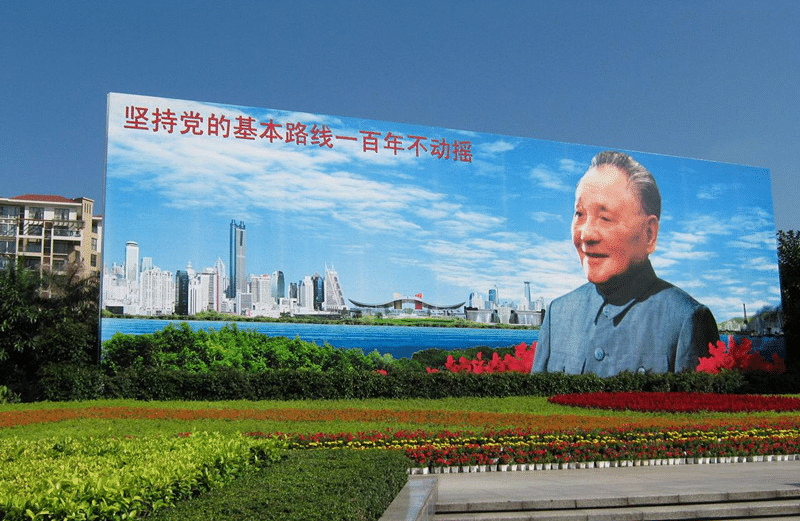
In 1980, China designated four special economic zones – Shenzhen, Zhuhai and Shantou in Guangdong, and Xiamen in Fujian. They were not free-market islands so much as laboratories: foreign investment was encouraged, land leases and labor rules were more flexible, and export processing was allowed. If the experiment failed, the cost would be confined to a few coastal strips; if it worked, it could be extended.
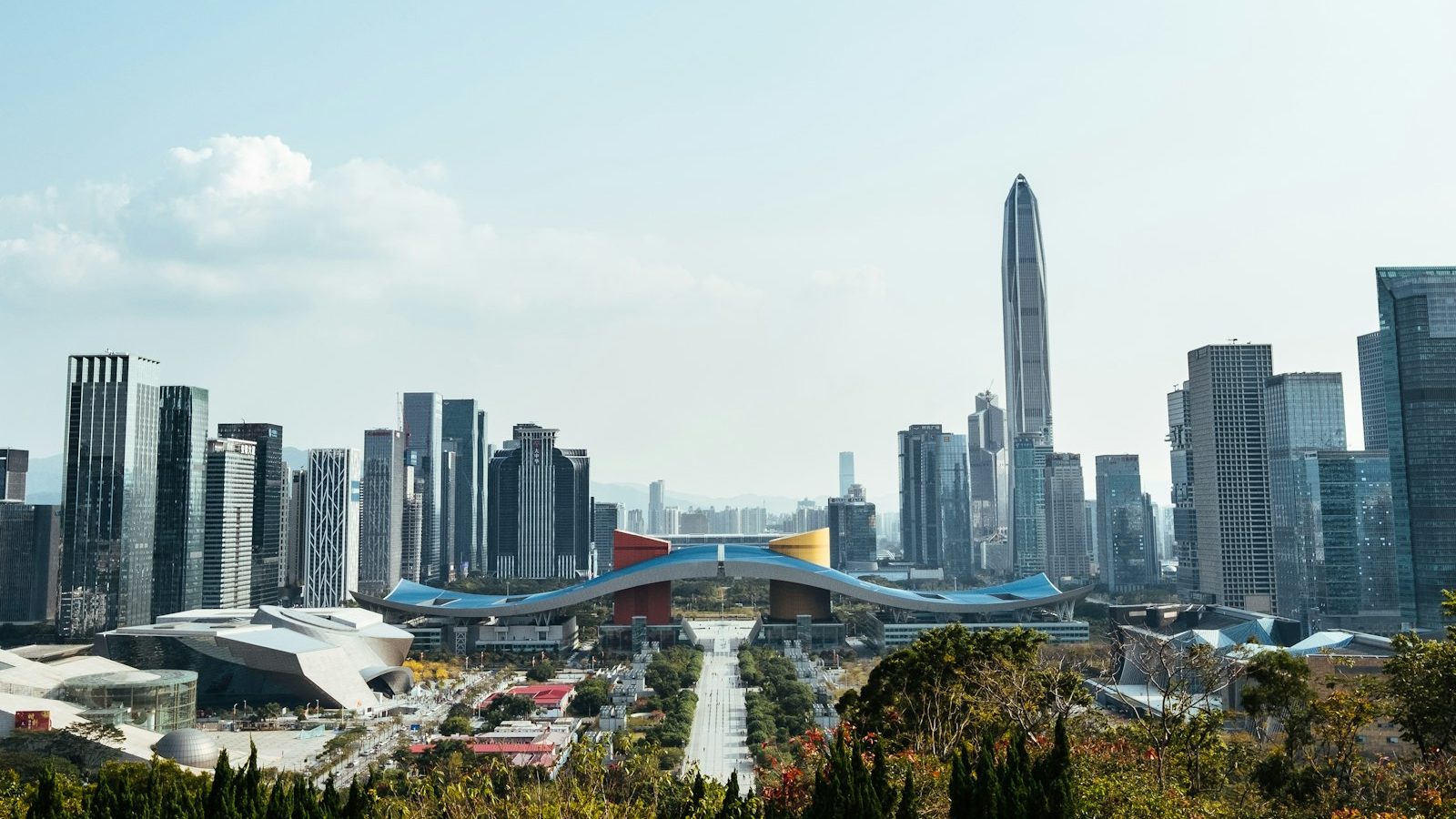
Shenzhen, then a town of fishing villages and farmland next to Hong Kong, is the case most often cited, and its growth over the following four decades was extraordinary by any measure. But the zone model also created the first sharp regional divergence: coastal provinces with ports and preferential policies pulled ahead of inland ones, and the gap proved durable.
The costs of the 1990s
If the 1980s were about agriculture and special zones, the 1990s were about restructuring state-owned industry – and this is the part routinely left out of summary accounts. Facing loss-making enterprises, the government adopted the slogan “grasp the large, let go of the small,” privatizing or closing thousands of smaller state firms and pushing larger ones toward commercial operation.
The human cost was concentrated. Academic estimates put the reduction in the state-sector workforce in the late 1990s at roughly 30 to 40 million people. These workers were formally “laid off” (xiagang) rather than dismissed: many kept a nominal relationship with the enterprise and received minimal support while losing most of the benefits attached to the job, including housing and healthcare. Industrial cities in the northeast – Shenyang, Harbin, Fushun – saw employment collapse within a few years. For a generation of urban workers who had been told their jobs were permanent, “reform” acquired a meaning the growth statistics never conveyed.
The social safety net had to be rebuilt at the same time. Enterprise-provided welfare had to give way to pensions, unemployment insurance and healthcare not tied to a workplace, and constructing those institutions took more than a decade. The Asian financial crisis of 1997 sharpened the pressure.
WTO accession and the export decade
China became the 143rd member of the World Trade Organization on 11 December 2001, after fifteen years of negotiations. Accession required tariff cuts, the opening of services sectors, and sweeping changes to domestic law. It is the clearest single date for the country’s integration into the global trading system.
The effects were large and uneven. World Bank data show trade’s share of China’s economy rising from about 21 percent of GDP in 1980 to nearly 50 percent in 2010, with much of the increase after 2001. Export manufacturing absorbed millions of rural migrants, and Guangdong became one of the world’s largest manufacturing regions. It also exposed Chinese industry to competition precisely where it was weakest, in parts of agriculture and heavy machinery, and accelerated the decline of inland state enterprises.
Who moved, and who stayed
The great social transformation of the reform era was migration. World Bank figures put China’s urban share of the population at just under 18 percent in 1978 and about 66 percent in 2024. Hundreds of millions of people moved from villages to cities over four decades, and their labor underwrote the export economy.
They did not move as equals. The hukou household registration system, inherited from the 1950s, tied access to public schooling, healthcare and some housing to a person’s registered locality. A migrant worker could work in Shanghai for twenty years and still send children to school in a different province, or pay higher fees to enroll them locally. Reforms since the 2010s have relaxed the system in smaller cities and allowed more rights in mid-sized ones, but the constraint has not disappeared – which is why urban population figures and “urban residents” in the legal sense are not the same thing.
What the aggregate numbers hide
The headline figures are well known and accurate. China’s GDP per capita rose from about 156 US dollars in 1978 to roughly 13,300 in 2024, according to World Bank data. The World Bank’s poverty measure – people living on less than 3 dollars a day at 2021 prices – placed 97 percent of the population below that line in 1981; the recent series shows it near zero.
Two other series matter as much. Inequality rose sharply: the World Bank’s Gini estimate was around 28 in 1981, exceeded 42 in the mid-2000s, and has since fallen back toward 36 in 2022. That trajectory is the shape of the reform itself – gains first concentrated among coastal cities and early entrepreneurs, then partly redistributed through social programs, migration and rural pensions.
The town-country gap reflects the same history. In 2025, per-capita disposable income reached about 56,500 yuan for urban residents and 24,456 yuan for rural residents, a ratio of roughly 2.31 to 1, down from 2.56 to 1 in 2020, according to official figures. The ratio has narrowed for over a decade but has stayed above 2 throughout, and rural incomes now include transfers and remittances as well as farm production.
Development indicators tell a similar story of large gains partly offset by pressures. UNDP’s Human Development Index for China stood at 0.797 for 2023, just below the threshold for “very high” human development. UNDP’s own research stresses that this national average hides wide regional disparities, demographic strain and environmental costs that are themselves part of the reform’s legacy.
Why the phrase still matters
Chinese policy documents still use “reform and opening-up” as a live programme rather than a historical episode, attaching it to financial liberalization, rural land reform and market access measures. That reflects a real continuity: the same test-and-scale method is still in use, and the same tensions – between state direction and market allocation, between coastal and inland development, between growth and environmental cost – are still unresolved.
The most useful correction for readers from outside is to drop the notion of a single turning point. Reform and opening-up was a forty-five-year series of decisions taken mostly under uncertainty, some reversed, many compensated unevenly. The visible results are real. So are the costs, and they were not distributed randomly. Understanding both is what makes the phrase explain something, rather than merely date it.
Sources: World Bank World Development Indicators, China GDP per capita (https://data.worldbank.org/indicator/NY.GDP.PCAP.CD?locations=CN); World Bank Indicators API for population, urban share, trade share, Gini and poverty series (https://api.worldbank.org/v2/country/CHN/indicator/SP.POP.TOTL); eChina.gov.cn / Xinhua on the household contract responsibility system (http://english.scio.gov.cn/featured/chinakeywords/2022-07/13/content_78321935.htm); WTO on China’s accession, 11 December 2001 (https://www.wto.org/english/thewto_e/acc_e/a1_chine_e.htm); WTO, China member information (https://www.wto.org/english/thewto_e/countries_e/china_e.htm); Garnaut, Song and Fang (eds.), China’s 40 Years of Reform and Development, ANU Press (https://press-files.anu.edu.au/downloads/press/n4267/html/ch28.xhtml); UNDP, Monitoring China’s Human Development, February 2026 (https://hdr.undp.org/content/monitoring-chinas-human-development-assessing-economic-and-social-progress-well); gov.cn / Xinhua on the 2025 urban-rural income ratio (https://english.www.gov.cn/archive/statistics/202602/04/content_WS6982fecfc6d00ca5f9a08e97.html). Verified 1 November 2026.