
Why a black egg scares people
Put a century egg in front of someone who has never seen one and the reaction is usually not curiosity. The white has gone to dark amber, translucent as smoked glass. The yolk ranges from olive to almost black, sometimes with a ring of grey-green. There is a faint smell of ammonia. In English it is called a century egg, a thousand-year egg, a hundred-year egg — names that sound like a dare.
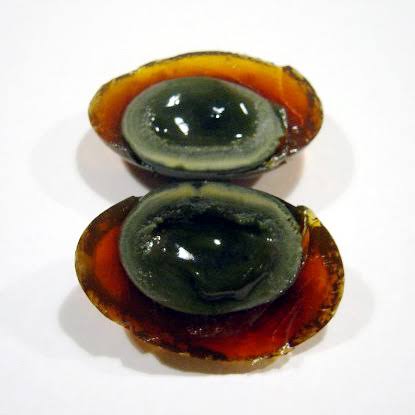
None of that is true. Nothing about pidan (皮蛋, literally “skin egg”) takes a hundred years. The whole process takes a few weeks. And the transformation is not rot, fermentation, or decay in any ordinary sense. It is chemistry — the same broad category of reaction that turns milk into yogurt or raw fish into ceviche, except pushed much further.
For anyone willing to look past the color, pidan is one of the more interesting things Chinese food has done with an egg, and one of the easiest to explain.
What actually happens inside the shell
A duck egg is mostly water and protein. The proteins are folded into specific shapes, held there by weak chemical bonds. Heat unfolds them — that is what cooking is — and they clump together into a solid network. That is why a boiled egg white goes from clear to opaque white and stays there.
Pidan does the same thing without heat, using a strong alkali instead. In traditional production, the eggs are coated in a paste of quicklime, plant ash, salt, and sometimes tea. In modern commercial production, the coating is usually a lye solution with salt and metal ions. Either way, the pH inside the egg climbs from around 7 to somewhere near 11 or 12.
At that pH, the proteins unfold and regroup into a gel. But this gel behaves differently from a boiled egg. It is bouncier, more elastic, and in good pidan it is slightly translucent — light passes through the white. The yolk, meanwhile, denatures more slowly, which is why a good pidan has a creamy, almost custard-like yolk inside a firm white.
The pale, fern-like patterns you sometimes see on the surface of the white are the origin of another Chinese name for the food: songhua dan (松花蛋), “pine flower egg.” Those patterns are crystalline deposits of amino acids and salts that migrated through the gel. They are not mold, and they are a sign of careful production, not spoilage.
The ammonia smell comes from the same process. Alkali breaks some of the amino acids down, releasing ammonia. It is strongest when the egg is freshly peeled and fades quickly. If you are serving pidan to someone nervous about it, that is worth knowing.
The lead question
Anyone looking into pidan will eventually read that it used to contain lead, and it is worth addressing directly rather than around.
For decades, lead oxide was used as a curing accelerator. It sped up the reaction and stabilized the gel. That is also why older people sometimes describe pidan as “a little bitter” or remember being told not to eat too much of it — lead accumulates in the body and causes real harm, particularly to children.
China phased this out. The lead-free process, developed from the 1980s onward and codified in national standards, replaces lead compounds with zinc or copper salts that do the same job. The current product standard, GB/T 9694-2014, covers preserved eggs made this way, and the national food safety standard for egg products, GB 2749, sets limits for contaminants. Commercially sold pidan in China today is expected to be lead-free, and packaging often advertises that fact.
This does not mean you should eat six a day. Pidan is high in sodium — roughly twice the sodium of a fresh egg, depending on the cure — and it is a preserved food, not a health food. But the lead panic that circulates in English-language coverage is mostly a story about the 1970s and 1980s, not about the egg in a supermarket today. If you buy pidan abroad, especially from an unregulated source or a market without labeling, that is a different situation, and lead-free labeling is worth looking for.
The nutrition itself is closer to a fresh egg than the appearance suggests. Calories and protein are comparable; the curing process does break down some protein, and studies have found pidan protein is more easily digested in vitro than boiled egg protein. Sodium is the main difference that matters in everyday eating.
Why the reaction is so strong
Part of the answer is color. Humans use color as a spoilage signal, and it is a good instinct almost everywhere. Dark green, grey, and black on animal protein usually mean something has gone wrong. Pidan trips that instinct on purpose, and the reaction is genuine, not a matter of cultural taste.
Part of it is the name. “Century egg” and “thousand-year egg” were invented for English-speaking audiences, probably to sound exotic. They are marketing language, and they have done the food no favors: they imply extreme age and decay when the reality is a few weeks of controlled alkalinity.
And part of it is that Western food media found the reaction funny. Pidan has appeared repeatedly on “world’s weirdest foods” lists, usually with a photo of a dark, glistening egg and a caption designed to produce a grimace. Those lists rarely explain how it is made or how it is eaten. They are not wrong that it looks strange. They are just not informative.
How it is actually eaten
If you want to understand why pidan is a staple rather than a stunt, the answer is in the dishes. It is rarely eaten plain by the slice, and it is almost never eaten as a snack. It works as an ingredient: rich, savory, slightly alkaline, and intensely flavored, which means a little goes a long way.
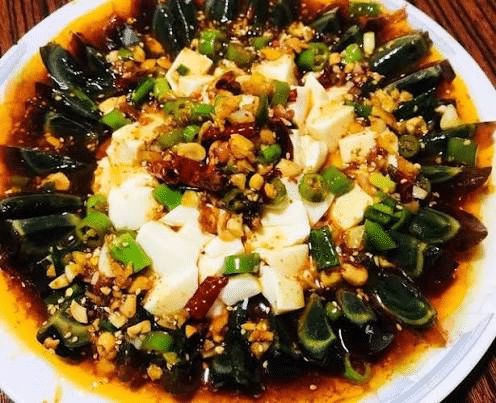
Pidan with silken tofu (皮蛋拌豆腐). Chilled silken tofu, sliced pidan on top, dressed with soy sauce, black vinegar, sesame oil, and often garlic and chili. This is the most common introduction for anyone new to the food. The tofu’s neutrality and the vinegar’s acidity balance the egg’s richness and the ammonia note. It takes about five minutes and requires no cooking.
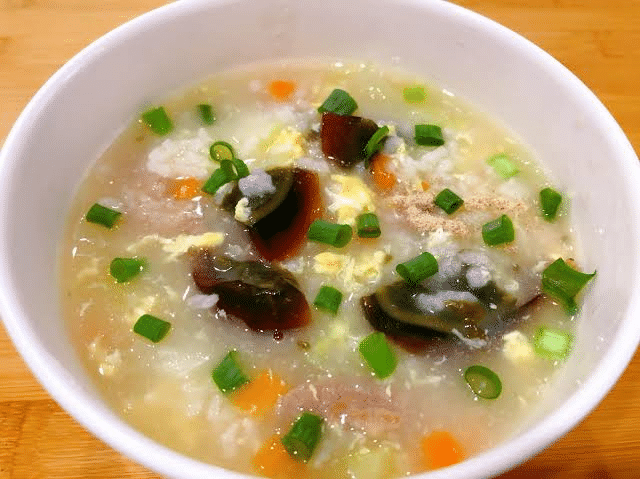
Pidan and pork congee (皮蛋瘦肉粥). The other staple, especially in Guangdong and Hong Kong, where it appears at breakfast, at dim sum, and late at night. Rice is cooked down into a smooth congee with shredded pork and ginger, and the pidan is added near the end so it melts into the porridge rather than turning rubbery. It is the dish most likely to convert a skeptic, because the pidan disappears into the texture.
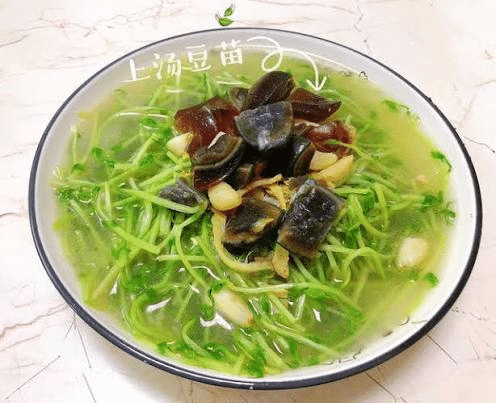
Pidan in superior broth (上汤皮蛋). A Cantonese approach: pidan cut into wedges and simmered briefly with stock, garlic, and leafy greens such as amaranth or bok choy. The yolk thickens the broth. This is a home dish more than a restaurant one, and it shows how pidan functions as a flavor base.
Pidan with pickled ginger (姜汁皮蛋). Slices of pidan with fine shreds of young ginger and a little vinegar. Common as a cold starter or a snack with rice. The ginger cuts the richness sharply, which is why the pairing is so standard.
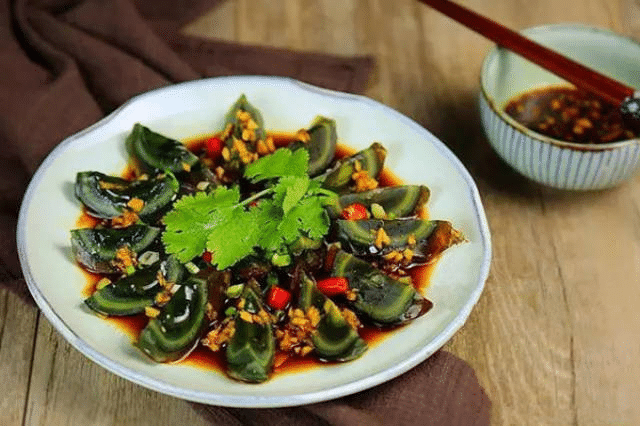
Beyond these, pidan turns up in pork congee variations across the south, in some Sichuan cold dishes, and in the occasional modern restaurant dish that treats it as a seasoning rather than a centerpiece. It is also, in some regions, eaten with nothing but a bowl of plain rice and a little soy sauce — which tells you something about how ordinary it is to the people who grew up with it.
A reasonable way to try it
Buy a lead-free one, ideally from a Chinese grocery with turnover. Peel it under running water; the shell can be stubborn. Cut it with a wet knife or a piece of thread, because the yolk smears. Serve it cold, with tofu, vinegar, and sesame oil. Do not eat it straight out of your hand the first time.
If you dislike it, that is a legitimate outcome. Plenty of people in China do not care for pidan either; it is a regional and generational preference, not a national obligation. But the reason to try it is not novelty. It is that the egg is a compact lesson in how a food culture solves a preservation problem — and then turns the solution into something people actually want to eat.