
The video was short, and it was not a polished production. A woman in her sixties, standing in what looked like a forest, holding a phone. She said she was looking for an American teacher. She had something she wanted to show him.
Her name is Yin Yuzhen. She lives in Salawusu Village, in Uxin Banner, in the Ordos region of Inner Mongolia. She posted that video in May 2026. Behind her were trees she had planted, some of them taller than she is. She had been trying to find the man who helped pay for them for twenty-six years.
She had his name: Ronald Sakolsky. She did not have an address, a phone number, or any idea whether he was still alive.
1985: a house in the sand
Yin moved to Salawusu in 1985, as a newly married woman. Her new home sat on the edge of the Mu Us Sandy Land, a semi-arid stretch of shifting sand on the southern rim of the Ordos plateau. The Mongolian name is often rendered as “bad water.”
It was not a desert in the postcard sense. It was worse in a quieter way: dry, windy, and mobile. Sandstorms half-buried the house. In interviews, Yin has described the early years simply, without much ornament. She has said she would rather wear herself out planting trees than let the sand defeat her.
So she started planting. Not as part of a programme, because in 1985 there was no programme waiting for her. Her husband, Bai Wanxiang, planted with her. They bought seedlings when they had money. They kept going through years when it would have been easier to leave.
1999: a television report, and a teacher in Henan
Fourteen years later, by her own account, she had a forest of a certain size and a reputation that had begun to travel. A television crew came. The report aired.
Roughly a thousand kilometres away, in Henan province, an American teacher was watching. Ronald Sakolsky was in China on a teachers’ exchange programme, teaching English at a school. He saw the report about a woman planting trees in the sand and decided he wanted to help.
He raised $5,000 and sent it. Chinese reporting describes the money as arriving through an American foundation. The sum, according to Chinese state media, was many times what Yin’s household earned in a year. No published English-language source gives an actual figure for that income, so the comparison should be read as a reported characterisation rather than a calculation.
What is not in dispute is what the money was for. Seedlings. Yin has said the funds let her buy “so many high-quality saplings” at a moment when cash was the binding constraint.
2000: a meeting, a pair of insoles, then silence
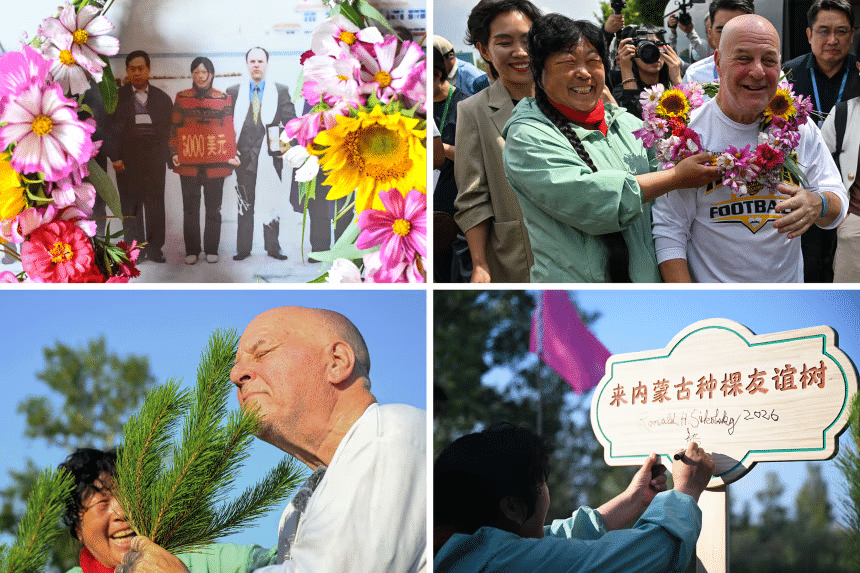
Sakolsky came to China, and in 2000 the two met in person. A photograph from that year shows them standing together in Uxin Banner. Yin had sewn him a pair of embroidered insoles overnight, as a thank-you. He took them home to Pennsylvania.
Then the two of them lost touch. Not dramatically — no falling out, no decision. Letters stop, addresses change, and twenty-six years pass. Yin kept planting. Sakolsky kept teaching, and then retired.
The trees, and the arithmetic nobody does
Here is where the story usually gets flattened, and where it is more interesting than the flattened version.
The saplings bought with Sakolsky’s money grew. Twenty-six years later, Chinese state media put the number at more than 50,000 trees, now standing more than 30 feet high. A grove near Yin’s home has been named after him.
But that 50,000 is not the size of Yin’s forest. Around her home, roughly 70,000 mu — about 4,667 hectares — has been planted with some 8 million trees since the mid-1980s, by Yin, her husband, their family, and others working alongside government programmes. The donation accounts for a fraction of one percent of the trees and a single chapter of a forty-year effort.
And that forest, in turn, is not the whole picture either. Nationally, China reports that 53 percent of its treatable sandy land has been effectively managed, largely under the Three-North Shelterbelt programme launched in 1978. That is a government statistic about a national campaign. It is not a statement about one farmer in Ordos.
Three numbers, three different scales: 50,000, 8 million, 53 percent. The viral version of this story merges them. Kept separate, they say something more useful — that a small gift to a person already in motion can matter without explaining the landscape.
2026: the video, and a phone call
By early 2026, Yin had been planting for four decades and had become, in the Chinese phrase, a national model worker — an official designation with its own media logic. She had also never stopped wondering about the American.
So in early May she posted the video. It spread. Former students and Chinese colleagues of Sakolsky saw it and contacted him by text and email. On 17 May 2026, the two spoke by phone. A recording of the call was released online the next day. In it, Yin invites him to come back and see the trees. Sakolsky says he hopes to return and plant one with her.
He described the reconnection as “a miracle.” He called her “a truly amazing woman.”
August: the walk into the forest
Sakolsky, by then 69 and retired, flew to China in August 2026 with his children. He arrived in Ordos on a Sunday and reached Salawusu the next day.
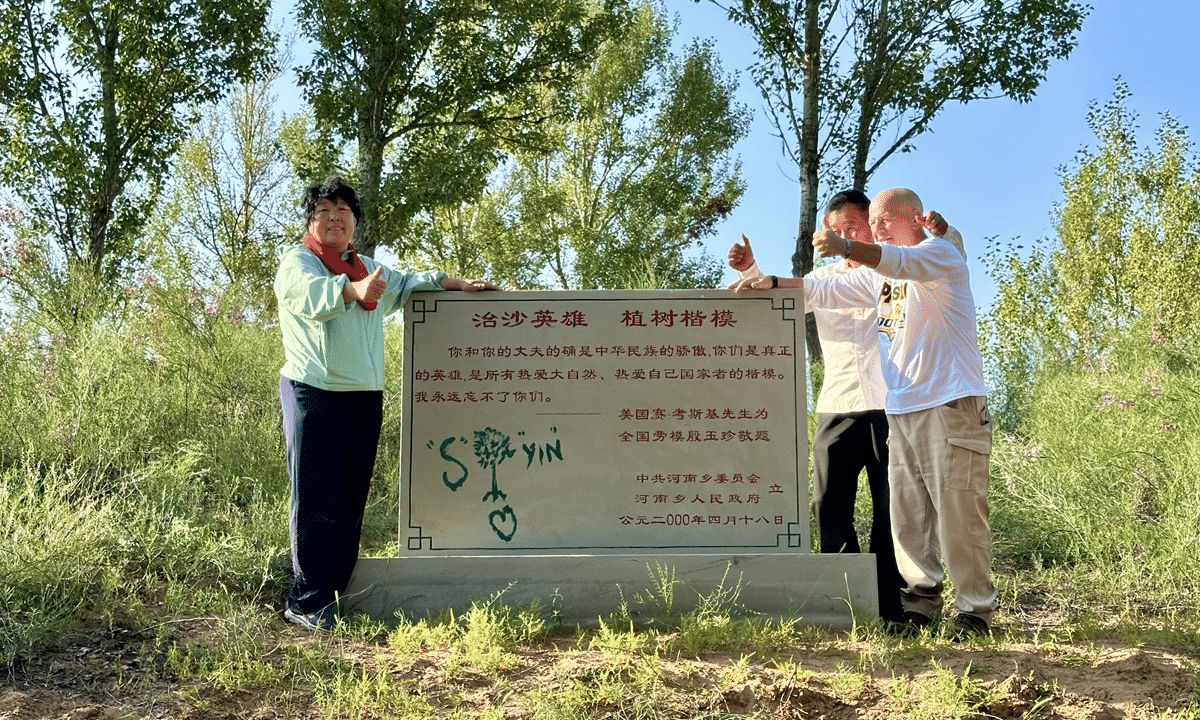
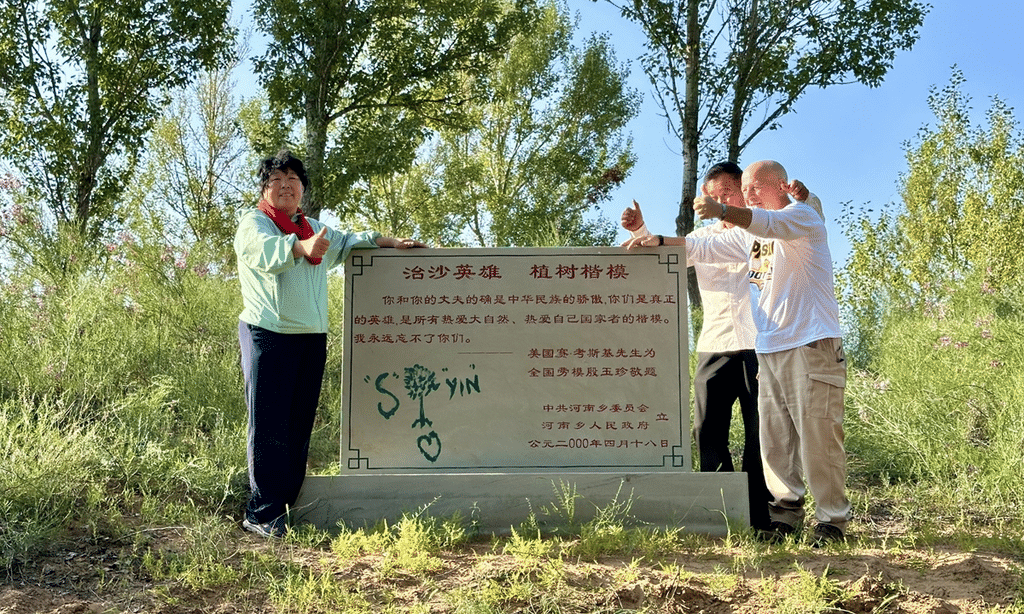
Xinhua’s photographers recorded the arrival in the flat, procedural way wire services do: Sakolsky greeting Yin’s family, Sakolsky with her grandchildren, Sakolsky being shown agricultural products, Sakolsky walking into the trees. One of those frames is a photograph of the two of them standing beside a tree they had planted twenty-six years earlier.
He had seen pictures, he told Chinese state media. He had been told all about it. “But until you see it is when you realize that it’s real.”
They planted a new sapling together. He collected a jar of sand to take back to Pennsylvania. Yin gave him a cross-stitch that read “One Earth, One Dream.” She told reporters she wanted him to know she had kept her word, and that “Chinese people keep our promises.” She called him her brother.
What the reunion does not settle
The reunion was covered widely, and it was also promoted. Xinhua filed photo essays. China Daily ran the tracking-down story in May and the reunion in August. In September, Xi Jinping mentioned Sakolsky by name in a toast at a White House state dinner, calling the story “a shining example of the friendly exchanges between our two peoples.”
the Three-North programme was “a great initiative in principle” but that Chinese authorities tend to emphasise “top-down, technocratic solutions” and to focus on targets more than quality. Early planting, she said, used “fast-growing but water-hungry” species such as poplars that depleted water tables, though more suitable species are used now. She also noted that restrictions on open grazing have been “a serious blow to some ethnic minority nationalities” whose livelihoods depended on it.
None of that erases what Yin did. It says that the story of a green China is larger and messier than a single grove, and that saying so is not the same as dismissing the people who did the planting.
The jar of sand
Sakolsky flew home at the start of September. In Beijing, before he left, he was asked what people should take from all this. He said that if everyone who watched the story went out and planted one tree, in a backyard or a park, it was worth imagining how many trees that would be.
He also said something that complicates the hero framing the coverage kept reaching for. On Facebook, he wrote: “I am not the hero of this story, Ms. Yuzhen is the miracle maker.”
Twenty-seven years earlier, a teacher in Henan saw a report on television, did some arithmetic about what he could afford, and sent money to a woman he had never met. She spent it on saplings, and then kept doing what she had already been doing for fourteen years. The part that made the story travel was never the money. It was that she remembered, and that she went looking.
Sources
- Xinhua, “China’s inspirational sand control efforts drive global desertification governance,” 17 June 2026. english.news.cn
- Xinhua photo report on the Sakolsky–Yin reunion, 24 August 2026. english.news.cn
- China Daily, “Chinese tree planter tracks down American donor 27 years after $5,000 gift,” 19 May 2026. chinadaily.com.cn
- Jennifer Jett, Erin Tan and Fred Dufour, “How an American teacher’s $5,000 donation helped turn a Chinese desert lush and green,” NBC News, 27 September 2026. nbcnews.com
- State Council of China, on 53% of treatable desertified land under effective management, November 2024. english.www.gov.cn
- Peer-reviewed literature on Mu Us Sandy Land vegetation drivers, including Ecological Indicators (2026) and Environment, Development and Sustainability (2024).
Quotations are taken from published English-language reporting. No dialogue, inner thought, or scene detail in this article has been invented; where a moment is described, it is drawn from a source listed above.