In late October 2026, the French footballer Kylian Mbappe did something that, for most of the world, looked bafflingly small. On a French talk show called The Bridge, he described a meme—one of the many that Photoshop his face onto the portraits of world leaders—and said, of Mao Zedong, “some guy—I think he’s a Chinese dictator.”
Within days, three major Chinese brands had dropped him, the state broadcaster had paused its coverage of his matches, and his accounts had been restricted on Chinese social media. To a reader in Paris or London, the question writes itself: over a joke?
This article is not about whether the reaction was proportionate. It is an attempt to explain, for readers who genuinely want to understand, why that one sentence landed the way it did in China—why it was not heard as a joke at all.
It was not meant as an attack
The first thing a fair explanation has to get right is that Mbappe almost certainly was not launching a political assault. The “dictator” meme has a history. Mbappe has been nicknamed the dictator in football circles, a teasing reference to his outsized influence over clubs, the media, and the game itself. Fans on social media have long pasted his face onto pictures of military and political figures as a running gag. During the 2026 World Cup, even his France teammate Ousmane Dembélé joined in, comparing him to Mobutu Sese Seko, the Congolese dictator.
Mbappe himself told the French magazine L’Équipe that he found some of these memes funny, while others showed “a lack of political and human awareness.” When asked on The Bridge which one he found funniest, he pointed to the Mao image. It reads, to a Western eye, like a footballer being glib about a silly internet trend rather than a man with a political point.
That matters, because the anger in China was never really about his intentions. It was about what the words meant to the people who heard them.
Two words, two different dictionaries
Here is the core of the misunderstanding. In much of the English-speaking and European world, “dictator” is a historical and political term. Applied to Mao, it sits within a well-established body of scholarship that treats him as an authoritarian leader—pointing to his centralized rule, the political purges, and the state campaigns that historians say led to the deaths of tens of millions of people. A French student can say “Mao was a dictator” the way they might say “the sky is blue,” and no one nearby would blink.
In China, the word does not function that way. Mao Zedong founded the People’s Republic of China in 1949, and in mainstream Chinese understanding he is a revolutionary figure who unified a broken country and built the foundations of a modern state. Many families keep a framed image of him in their homes. The official position is that his contributions outweighed his mistakes. Whatever a Western historian might argue, calling Mao a “dictator” in China is not heard as an academic judgment. It is heard the way a French person might hear a foreigner reduce Joan of Arc to “that woman who heard voices,” or the way an American might hear a stranger dismiss George Washington as “a slaveholder and nothing more.” The same historical figure, the same facts—but the word lands on entirely different emotional ground.
It is worth being precise here. This is not a claim that one side has the correct history and the other is wrong. It is simply the mechanism of the collision: a term that is neutral shorthand in one culture is a grave insult in another. Mbappe used the Western dictionary. Millions of Chinese people heard him through theirs.
He knew what it felt like to be the target
This is the part that sharpened the anger, and it is the part most foreign coverage underplays.
Three months earlier, in July 2026, during the World Cup, Mbappe had been the victim of a racist attack. After France beat Paraguay in the round of sixteen, a Paraguayan senator named Celeste Amarilla called him a “colonised Cameroonian, desperately trying to pass as French”—and worse. Mbappe responded fiercely, calling her “despicable” and unfit for her office. The French Football Federation announced it would file criminal charges. The French president, Emmanuel Macron, publicly backed him. Prosecutors opened an investigation.
He was, quite rightly, defended by his country and by much of the world. A person was demeaned for who he is, and the people around him said so loudly.
Now fast-forward three months. The same man, asked about a picture of another country’s founding leader, reached for a word that millions of people in that country experience as a slur against their own national story—and did so with the casualness of someone ordering a coffee. For many Chinese observers, that contrast was the wound. A man who knew, from his own skin, what it feels like to be mocked for something you cannot change, seemed not to extend the same awareness to someone else’s heroes.
The logic, as it circulated on Chinese social media, was not subtle: You demanded the world treat your identity with respect. Why was ours treated like a punchline?
He was making money in the room where it hurt
There is one more layer, and it turns a matter of hurt feelings into something with a price tag.
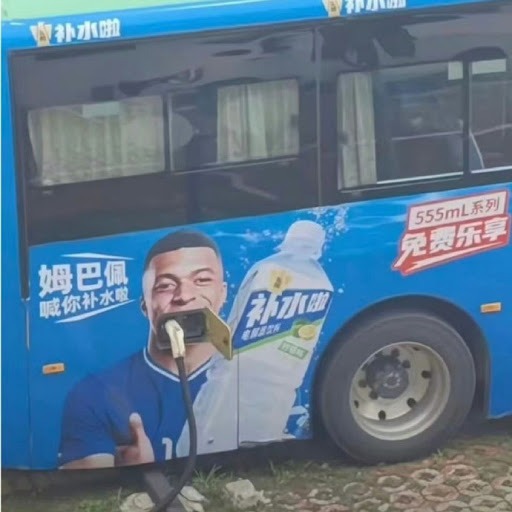
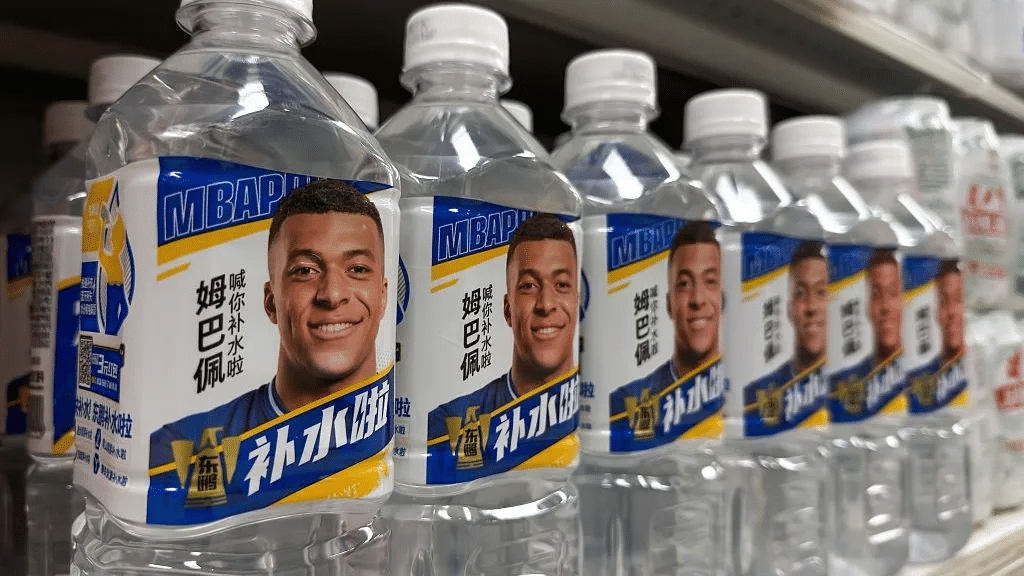
Mbappe was not a stranger to China. He was one of its most commercially bankable foreign athletes, nicknamed affectionately by fans—Guigui, after a Teenage Mutant Ninja Turtle, for a perceived resemblance. He endorsed Mengniu, China’s largest dairy producer, and Dongpeng, a major beverage brand. Those two contracts alone were worth roughly 50 million yuan, or about €6.7 million, according to French newspaper Le Monde.
So the sequence, from a Chinese point of view, looked like this: a man earned handsomely from Chinese consumers, enjoyed enormous popularity in China, and then—in a moment of glibness—used a word that those same consumers experience as an insult to their founding leader. The brands responded within days. Mengniu, Dongpeng, and the cheesemaker Milkground all announced they were ending their partnerships, citing a “zero-tolerance policy” toward words that offend the feelings of the Chinese public. CCTV suspended broadcasts of Mbappe matches and LaLiga fixtures. Global sponsors including Dior, Nike, and Hublot quietly removed promotional content from Chinese social media.
To a Western observer, this can look like a boycotts-for-hire system, brands terrified of a mob. And there is truth in that: Chinese consumer boycotts are real, and they move quickly. But to frame it only as fear misses the point. The brands were reading a market. In that market, respect for the country’s historical figures is not an abstract virtue—it is table stakes for doing business. A company that sells milk to a hundred million families cannot afford to be seen shrugging at what those families experience as an insult.
The line you do not cross
There is a broader context that helps, and it is uncomfortable for foreign readers to hear without it being an endorsement.
Mocking Mao is not, in China, a matter of taste. It is one of the most politically sensitive acts a person can perform. Satire aimed at Mao has, in recent years, carried real consequences. In August 2026, an artist named Gao Zhen was sentenced to three years in prison for satirical sculptures of Mao, including one that depicted him kneeling in repentance. The official phrase was that he had “infringed upon the reputation of heroes.” Whatever one thinks of that sentence, it tells you something essential: in China, Mao is not an ordinary historical figure you are free to joke about. He sits in a category of protected national memory, alongside the idea of the nation’s founding itself.
A Western reader might reasonably object that no historical figure should be immune to criticism, and that is a legitimate argument. This article is not asking you to agree with the line. It is asking you to understand that the line exists—and that for most Chinese people, it is not a line imposed on them by a government, but a boundary they feel internally, the way citizens of any country feel about the figures who symbolize its survival and identity.
What respect actually means now
Mbappe apologized, in three languages, saying his comment was “ill-judged” and that he had “deep respect for the Chinese people and their history.” CCTV, in response, said it hoped he would “genuinely learn a lesson from this.” LaLiga’s president flew to meet the Chinese ambassador in Spain to keep the relationship intact.
The episode has no clean ending, and this article will not manufacture one. What it offers is a clearer question. In a world where a single careless sentence from a footballer in Paris can reach a billion people in a day, “respect” stops being a pleasant abstraction and becomes a practical skill: knowing that the same word, the same joke, the same two-second clip, carries different weight depending on which side of the planet it lands.
Mbappe did not set out to insult China. But intention was never the issue. The issue was that he reached for a word that, in the room he had just entered, is not a word at all—it is a wound. And he did it while holding the microphone, the sponsorship deals, and the affection of the very people whose history the word dismissed.
That, more than any political system or media campaign, is why a one-second joke about a man he had never met made millions of people—people who had once cheered his name—turn away.
Sources
- TIME — Mbappe Apologizes After ‘Dictator’ Mao Comment: link
- Reuters — Mbappe dropped by Chinese brands over alleged Mao meme comments: link
- BBC Chinese — apology statement: link
- Deutsche Welle Chinese — CCTV suspension: link
- Al Jazeera — Paraguayan senator’s racist attack: link
- The Guardian — French prosecutors investigate racist abuse: link
- Guancha (观察者网) — Chinese-language coverage of the July racist attack: link