
Ask a Chinese friend which animal they are and the answer comes quickly: horse, rooster, pig. Ask what that animal actually determines, and the picture gets murkier. The zodiac is one of the most widely recognized Chinese cultural exports and one of the least understood in its own terms. Most of what English readers find online is a horoscope, a personality profile, or a retelling of the Jade Emperor’s race that never explains why the calendar counts the way it does.
The short answer: the twelve animals are not a fortune-telling system first. They are a mnemonic attached to a much older counting system, and your birth year is a position in a sixty-year cycle, not a personality quiz. Once you see the machinery, the popular version stops looking like superstition and starts looking like a calendar with a folk layer on top.
Twelve animals, twelve branches
Before the animals there were the Earthly Branches (dizhi, 地支): twelve ordered signs, Zi, Chou, Yin, Mao, Chen, Si, Wu, Wei, Shen, You, Xu, Hai. They were used to mark time long before anyone drew a rat or a dragon next to them. The branches also name the twelve traditional “double hours” of the day — Zi runs from 23:00 to 01:00, Chou from 01:00 to 03:00, and so on — and they carry associations with directions and seasons.
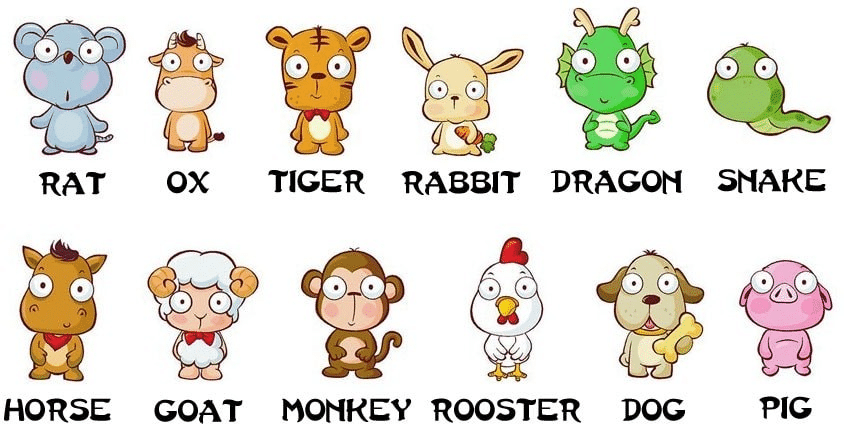
The animals were added later as a memory aid. Rat for Zi, Ox for Chou, Tiger for Yin, on through Pig for Hai. That is the order you will see on every zodiac chart: Rat, Ox, Tiger, Rabbit, Dragon, Snake, Horse, Goat, Monkey, Rooster, Dog, Pig. The sequence is fixed, and it is fixed because the branch sequence underneath it is fixed.
Why the cycle is sixty years, not twelve
The second half is the ten Heavenly Stems (tiangan, 天干): Jia, Yi, Bing, Ding, Wu, Ji, Geng, Xin, Ren, Gui. Stems and branches advance in lockstep, one position per year: Jia-Zi, Yi-Chou, Bing-Yin, and so on.
Ten and twelve share a factor of two, so their least common multiple is sixty. After sixty steps both sequences return to the start at once. There is no mystical reason for sixty; it is what happens when you advance a ten-item list and a twelve-item list at the same speed.
One consequence confuses almost everyone. Because both sequences move together, only certain stem-branch pairs ever occur. Jia can only pair with Zi, Yin, Chen, Wu, Shen, or Xu — never with Chou, Mao, Si, Wei, You, or Hai. There are sixty possible combinations, not 120, and the cycle is called liushi jiazi (六十甲子), the sixty jiazi.
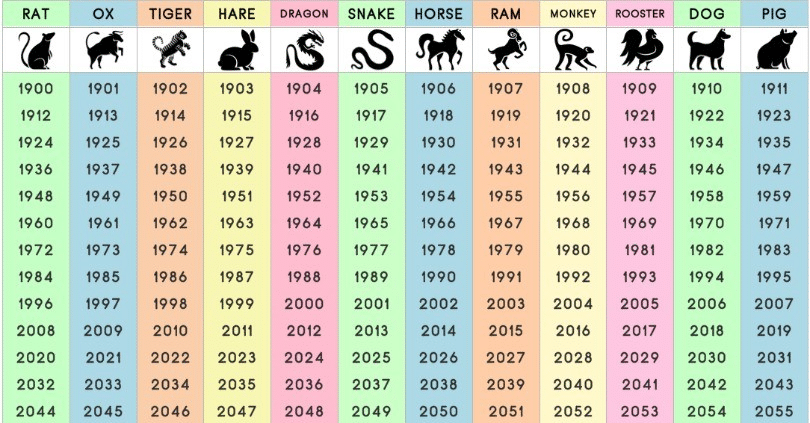
In practice, this means the animal repeats every twelve years, but the full year designation repeats only every sixty. A Horse year is not just a Horse year: recent ones have been Geng-Wu (1990), Jia-Wu (2014), and Bing-Wu (2026). The stem also carries a Five Phases association, which is why English coverage talks about “Wood Dragon” or “Fire Horse.” That layer is a later interpretive addition; the stem’s earliest role appears to be purely calendrical.
February birthdays: which animal are you?
Here is where the questions really start. If you were born in early February, the “year of your birth” is ambiguous in Chinese terms, because the Chinese year does not begin on January 1 and, depending on who you ask, may not begin when the lunar new year does either.
Two schools exist. The Chinese New Year school says the new animal begins on the first day of the first lunar month. That is how the national standard treats it: GB/T 33661-2017, which governs how the Chinese calendar is compiled and issued, defines the zodiac year as running from the first day of the lunar new year to the day before the next, mapped onto the stem-branch year. Under that standard, the Jia-Zi year began on February 2, 1984 — and the Rat with it.
The Start of Spring school says the animal changes at lichun (立春), the solar term that falls around February 4. This is the convention used in four-pillar astrology (bazi) and much of traditional divination, where the year pillar is calculated from the solar year, not the lunar one. Because lichun and the lunar new year fall a few days to a couple of weeks apart, someone born in that gap has two possible animals.
Popular Chinese science writing has argued that the lunar new year is the older and more accurate reading — that the zodiac was a way of counting years in the everyday calendar, that the historical record uses birth dates rather than solar terms, and that the Start of Spring convention spread in the twentieth century, partly through privately printed almanacs after the imperial calendar monopoly ended. That is a defensible position, but it is one side of a live argument, not a consensus. Practitioners working in the bazi tradition give the other answer.
For ordinary social use, the lunar new year decides. For a birth chart, lichun probably does. If someone is born on one of those few days each year, it is better to name the convention than to insist on one.
What benming nian actually is
Every twelve years your animal comes back around. That year is your benming nian (本命年), literally “the year of one’s original destiny” — your zodiac birth year.
The logic is counterintuitive to outsiders who assume your zodiac year would be lucky. In folk practice it is widely treated as a year to be careful, sometimes described as a year when you “clash with Tai Sui,” the deity associated with the year. The traditional response is red: underwear, belts, socks, bracelets, string, ideally worn close to the body all year. Older relatives often buy these things for you, and the retail response is predictably large.
Why red? Chinese popular explanations trace it to a long-standing association of red with celebration, protection, and the warding off of harm — red is the color of wedding invitations, door couplets, and envelopes of cash at the new year. The folk belief is that red repels the bad luck the year would otherwise bring. There is no scientific basis on offer. The honest description is a widely observed folk practice whose symbolism is broadly agreed and whose precise history is diffuse.
How seriously people take it varies by age, region, and family. Plenty of young urban Chinese roll their eyes at the whole idea and still accept the red socks their mother buys. The belief is real enough to shape retail and loose enough that most people treat it as a mild tradition rather than a threat.
Does the zodiac affect birth rates?
Sometimes, and less than the stories suggest. The dragon has the strongest reputation: children born in dragon years are popularly believed to be especially fortunate and capable, and there is documented evidence of a birth bump. Statista’s analysis of National Bureau of Statistics data notes that births rose to around 14.5 million in 2012, the previous dragon year, and that 2024 showed a visible dragon-year increase on top of an otherwise steep decline. A 2024 Straits Times report on the same phenomenon quoted China’s birth rate rising from 13.27 per thousand in 2011 to 14.57 per thousand in 2012, before falling back to 13.03 in 2013.
The caveat is that the bump is small against the trend, and not every dragon year shows one. Statista’s own reading is that 2000 and 1988 did not stand out from the surrounding trend. A sociologist quoted by the Straits Times made the sensible point that an auspicious year can nudge couples who already intended to have a child, but does little for reluctant ones. The broader decline is driven by housing costs, employment pressure, changing attitudes to marriage, and the expense of raising a child; a zodiac year is a rounding error next to those.
Older claims about “zodiac baby planning” and sex-selective preferences are a separate and more sensitive matter. There is a large, well-documented literature on son preference and skewed sex ratios at birth in China, but attributing it to zodiac beliefs rather than to the deeper social and economic drivers would be a mistake. An article that turns it into “Chinese people plan around dragon years” is making the same error as the horoscope column, in another direction.
What the zodiac is, in one paragraph
It is a calendar dressed up as a set of animals. The animals exist because the twelve branches needed shorthand; the sixty-year cycle exists because ten stems and twelve branches advance together; the boundary disputes exist because Chinese timekeeping has more than one legitimate new year. Personality claims, compatibility advice, and red underwear are a folk layer grown on top of that counting system, and they vary by family, region, and generation.
That is why the internet’s zodiac industry sits uneasily on the real thing. “You are a Horse, so you are ambitious and impulsive” is entertainment, not tradition. What the tradition does is place you in a cycle that has run for a very long time — a stranger claim than any personality profile.
Sources: Sexagenary cycle and Chinese zodiac, Wikipedia (accessed 2026-10-30); “Heavenly Stems and Earthly Branches,” chinese-festival.com; “Heavenly Stems and Earthly Branches,” thechinajourney.com; “Chinese Zodiac,” chinesenewyear.net; “Chinese Zodiac,” chinahighlights.com; Sun Zhengfan, “生肖到底按春节还是立春,” 科普中国/腾讯新闻, 2026-02-16; “Are ‘Dragon Babies’ Bumping up China’s Birth Rate?” Statista, 2025; “Baby boom expected in China during Dragon Year not enough to save fertility crisis,” The Straits Times, 2024; GB/T 33661-2017, 农历的编算和颁行, Standardization Administration of China.