
A perspective from China
Every year, between late January and mid-February, hundreds of millions of people in China start going home. Trains fill up, shops close, and red decorations appear in windows and doorways. This is Chinese New Year, known in China as 春节 (Chūnjié), the Spring Festival. For many Chinese people it is the most important time of the year, and I’d like to explain what it means beyond the fireworks and red envelopes that most outsiders see.
What It Is, and When
Chinese New Year marks the start of a new year in the traditional Chinese lunisolar calendar. That calendar follows both the moon’s phases and the sun’s seasonal cycle. Because of this, the festival has no fixed date on the Gregorian calendar. It falls on a different day each year, always between about January 21 and February 20. In 2027 it falls on February 6, beginning the Year of the Goat. (The animal is also translated as “sheep” or “ram”, and the Chinese character 羊 covers all of them.)
Traditionally the festivities run from New Year’s Eve to the Lantern Festival on the 15th day of the first lunar month. Today’s official public holiday is shorter, and the length is set by the government each year.
The name “Spring Festival” reflects its agricultural roots. It was a celebration at the turn of the farming year, welcoming the season of renewal.
The Story of Nian, and What It Is
Many introductions mention the legend of Nian, a beast said to come out on New Year’s Eve and frighten villages. People supposedly learned it feared the color red, fire, and loud noises. This is the traditional explanation for red decorations and firecrackers.
It is folklore. Scholars do not treat it as the festival’s documented historical origin, and the festival almost certainly grew out of many older practices over a very long time, including agricultural rites, ancestor veneration, and seasonal ceremonies. The legend is a good way to understand how Chinese people tell the story of their own traditions, but it should not be read as history.
The Heart of It: Reunion
If I had to pick one word for Chinese New Year, it would be reunion (团圆, tuányuán).
Millions of people work or study far from their hometowns, especially migrant workers who moved to large cities. During the festival they return to their families. This produces chunyun (春运), the seasonal travel rush, which is often described as the largest annual movement of people in the world. Government figures put the trips in the billions over the roughly 40-day period, though counting methods count one person making several trips separately.
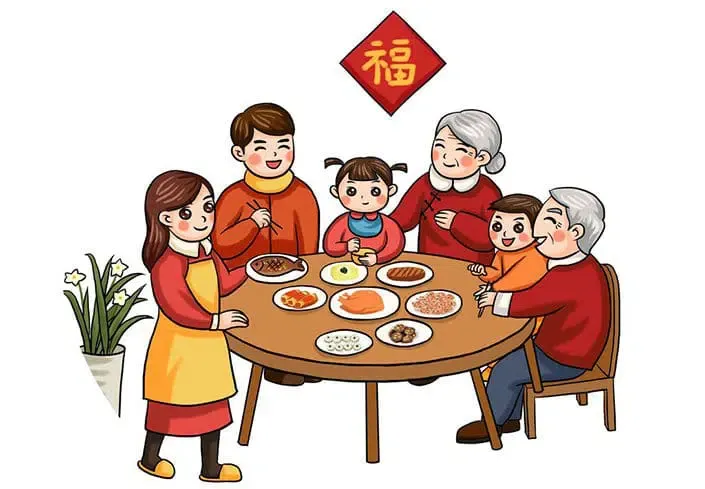
The center of the festival is the New Year’s Eve dinner, when family members gather around one table. Dishes often carry symbolic meaning through wordplay: fish (鱼, yú) sounds like “surplus” (余), and dumplings (饺子) in northern China resemble ancient ingots. The meanings are part of the fun, and families do not all observe them the same way.
Common Customs
- Cleaning the house before the new year, often explained as sweeping away bad luck to make room for good.
- Red decorations, including couplets (春联) pasted beside doors, paper cuttings, and lanterns. Red is associated with good fortune and joy.
- Red envelopes (红包, hóngbāo) containing money, traditionally given by elders and married adults to children and unmarried younger people. Digital red envelopes sent through phone apps are now very common.
- Visiting relatives and friends, and exchanging greetings such as 新年快乐 (xīnnián kuàilè) or 恭喜发财 (gōngxǐ fācái).
- The Lantern Festival, which ends the season with lantern displays and sweet glutinous rice balls (汤圆).
- The CCTV Spring Festival Gala, a televised variety show running since 1983, which many families watch on New Year’s Eve.
It Is Not One Uniform Tradition
This is a point I think matters for an honest explanation. Customs differ a lot by region, ethnic group, generation, and family:
- Northern families often eat dumplings, while many southern families favor rice cakes (年糕) or other local dishes.
- Some ethnic minority groups in China celebrate their own new year at different times.
- Urban young people sometimes travel abroad for the holiday, order restaurant meals, or hold the reunion dinner outside the home.
- Many Chinese cities have restricted or banned firecrackers over safety and air quality, so the loud tradition of my parents’ generation is less common in many places today.
Nor is the festival only Chinese. The Lunar New Year, in different forms, is celebrated in Vietnam (Tết), Korea (Seollal), and parts of other countries, as well as by Chinese communities around the world. Each has its own customs and its own history, and it would be inaccurate to treat them all as variants of “Chinese” New Year.
Global Recognition
In December 2024, UNESCO inscribed the Spring Festival, described as the social practices of the Chinese people in celebration of the traditional new year, on its Representative List of the Intangible Cultural Heritage of Humanity. UNESCO noted that the festival includes practices such as prayers for good fortune and family reunions, and that its traditions are passed down both informally in families and communities and formally through education.
More Than a Holiday
So why call it “more than a holiday”? To many Chinese people, it works as a yearly reset of family ties. Because so many people live far from home for most of the year, it is the one reliably shared moment for being together. It also connects people to the generations before them, since many families honor ancestors during the festival.
For visitors and friends from other countries, the best way to approach it is with curiosity. Ask your Chinese friends how their family celebrates, since the answer will probably differ from any article, including this one.
References
- Xinhua / China Daily (5 December 2024), “UNESCO inscribes Spring Festival on intangible cultural heritage list.” Reports the inscription at the 19th session of the Intergovernmental Committee for the Safeguarding of the Intangible Cultural Heritage, held in Paraguay.
- UNESCO, Intangible Cultural Heritage, Representative List: “Spring Festival, social practices of the Chinese people in celebration of traditional New Year” (ich.unesco.org).
- Bodde, Derk (1936), Annual Customs and Festivals in Peking, a translation of Dun Lichen’s Yanjing Suishi Ji. A classic historical source on traditional festival customs.
- Encyclopaedia Britannica, entries on “Lunar New Year” and “Chinese calendar” (britannica.com), for the calendar system and its regional variations.