
For five decades, the story of who built the Terra-cotta Army has been told with a striking absence of evidence. The assumption that the emperor’s clay soldiers were the work of adult men was rarely tested — it was simply inherited. A new study published in the Journal of Cultural Heritage has now put that assumption under a microscope, or more precisely, under a fingerprint scanner.
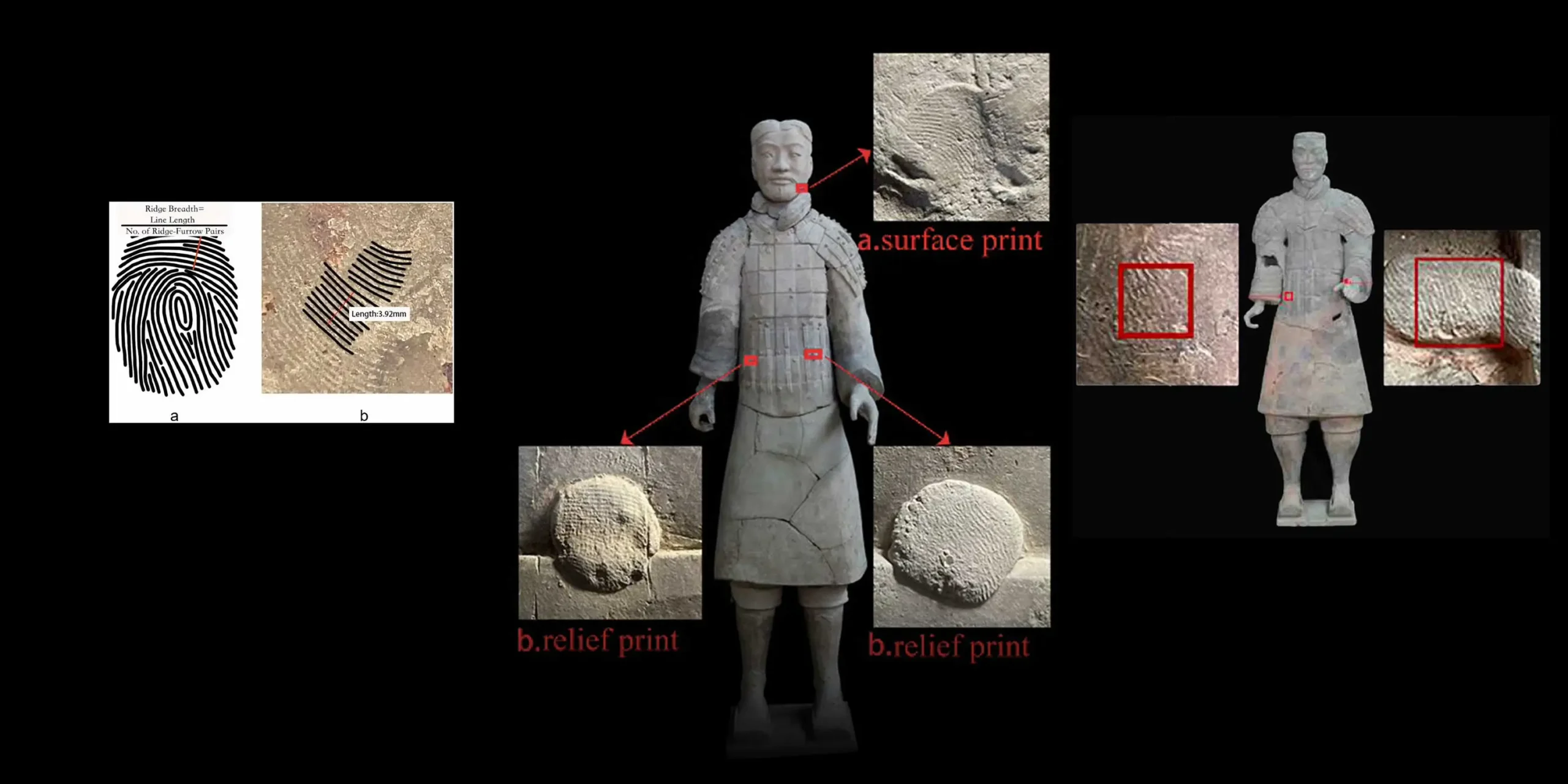
The researchers examined 79 well-preserved fingerprints pressed into the unfired clay of 36 warriors in Pit 1 of the mausoleum of Qin Shi Huang, China’s first emperor. Their conclusion: the workforce behind the 2,200-year-old army was not exclusively male. The team estimates that roughly 45% of the fingerprints came from adult men, 32.7% from adult women, and 22.3% from juveniles under the age of 15.
Why fingerprints, and why now
The Terra-cotta Army was discovered in 1974 when farmers digging a well near Xi’an unearthed fragments of life-sized clay figures. The site has since yielded around 8,000 warriors, 130 chariots, 520 horses, and another 150 cavalry horses. Much of the necropolis remains unexcavated.
What has been far less studied is the identity of the people who made the figures. Previous research focused heavily on how the army was manufactured — clay composition, workshop organisation, assembly techniques — while the question of who did the work was largely settled by assumption. Historical texts describing Qin dynasty labor systems (221–206 BC) typically treated men as the default workers, with 15 reportedly the minimum age for service.
But the artisans left something behind beyond their work. When they gripped a head to attach it, smoothed an arm, or pressed a decorative armor nail into place, they pressed their fingers into wet clay. Those impressions survived firing and two millennia underground.
The method is less obvious than it sounds
Fingerprint analysis of ancient craftspeople is not new, but earlier attempts have been methodologically shaky. A fingerprint’s size tells you little, because the real signal is in the spacing between the ridges. Ridge breadth increases as a person grows, then levels off at skeletal maturity — and after that point, men tend to have slightly wider ridge spacing than women.
That is the theory. The problem is overlap. An adolescent boy’s fingerprints can be nearly indistinguishable from an adult woman’s. Ancient populations may differ from modern ones. And clay shrinks when it dries and is fired, distorting the original measurements.
The team, led by archaeologist Xiaoxi Li of the Emperor Qinshihuang’s Mausoleum Site Museum in Xi’an, working with Shandong University’s School of Archaeology, avoided the trap of trying to assign a sex and age to each individual print. Instead they used a Bayesian mixture model to estimate the proportions of demographic groups across the whole assemblage, while adjusting for population differences and clay shrinkage.
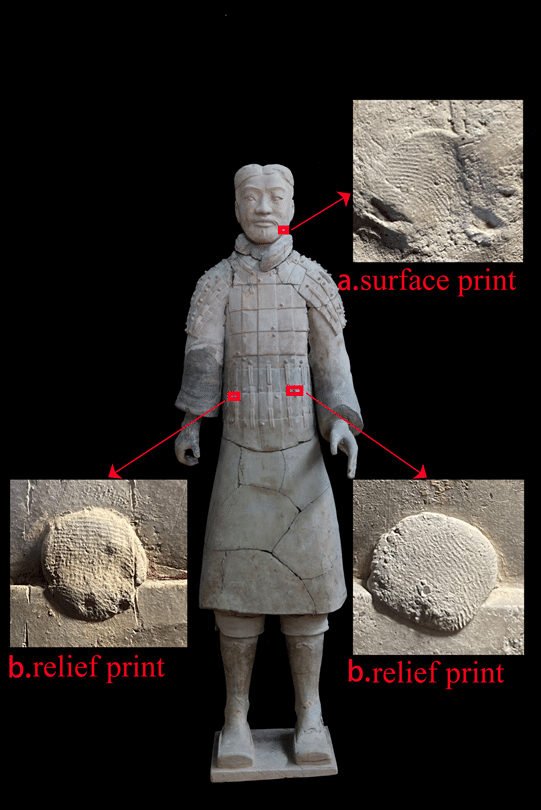
Of the initial 91 fingerprints documented, 12 were excluded because they appeared to come from individuals who had left multiple prints. The remaining 79 came from heads, arms, armor, hands, collars, and in one case a foot. Seventy-three were surface impressions left during molding, shaping, and assembly; six were relief impressions formed when pre-made decorations were pressed onto the surface.
What the numbers can and cannot tell us
The headline figures are vivid, and the researchers are careful about them. In their paper they note that the percentages describe the fingerprints, not the people. One worker could have left several prints; another none at all. Experienced artisans, who handled the clay with more control, may have left fewer impressions than apprentices fumbling with components — which could inflate the apparent share of juveniles.
There is a second, more technical caveat that matters for how the result should be read: the reference database used to calibrate the model was built from modern Czech-Caucasian fingerprints, not East Asian ones, and contained more female samples. The authors acknowledge this could skew the estimates toward overstating the proportion of women and young people.
So the defensible claim is narrower than some coverage implies. The study does not establish that 33% of the Terra-cotta Army’s makers were women. It establishes that this assemblage of fingerprints cannot be explained by a workforce of adult men alone.
Not an anomaly, but a pattern historians already suspected
The most persuasive thing about the finding is not that it is surprising in isolation. It is that it fits evidence from elsewhere in the Qin state economy.
Inscriptions on Qin dynasty lacquerware contain terms referring to adult women, young girls, and young boys involved in production. The Qin also operated a formal apprenticeship system: legal manuscripts known as the Yuelu Academy Qin slips state that “the master artisan teaches well; thus an apprentice completes training in one year, a new artisan in two years.”
That structure suggests a plausible division of labor inside the workshops: younger, less experienced workers handling simpler tasks such as attaching decorative details to armor, while skilled artisans took on the technically demanding sculpting. The fingerprint pattern — with relief impressions clustering on armor components — is at least consistent with that arrangement, though the study cannot prove task assignment directly.
The authors put it plainly in their paper: the biological evidence “highly corroborates numerous historical records, vividly reconstructing the production scene in the Qin dynasty’s state-run workshops where men and women served together, and adult artisans worked alongside juveniles, who may have been helpers or apprentices.”
A small sample with a large implication
The study’s scope is worth stating without decoration: 36 figures in one unit of one pit, out of thousands of figures across a site that is still mostly unexcavated. It is not a census of the Qin workforce, and its authors do not claim it is.
What it does offer is a replicable method for asking a question that archaeology has often answered by default. If fingerprints preserved in clay can be read statistically, then other sites with surviving impressions may eventually yield similar evidence — and the assumption that monumental ancient projects were built by adult men alone may turn out to be less a finding than a habit.
Why this matters beyond the pit
The Terra-cotta Army is usually presented as a monument to one man’s ambition and to the scale of Qin power. Both are true. But the fingerprints complicate the image in a useful way: a state project of extraordinary ambition, executed by a mixed workforce that included women and children, inside an institutional system that appears to have trained them deliberately.
That is a more specific and more human picture than either the old assumption or the newer headline. It also sits awkwardly with the way the site is usually described to visitors — as a wonder of ancient engineering, with very little said about the people whose hands actually shaped it.
The full study, “Who produced Emperor Qin Shihuang’s Terracotta Army, China? A Bayesian mixture model approach to fingerprint age and sex determination,” is published in the Journal of Cultural Heritage.
Sources
- Li, X., Shen, J., et al. “Who produced Emperor Qin Shihuang’s Terracotta Army, China? A Bayesian mixture model approach to fingerprint age and sex determination.” Journal of Cultural Heritage, vol. 82 (2026). DOI: 10.1016/j.culher.2026.09.014
- Michelle Starr, “2,200-Year-Old Fingerprints Reveal Who Really Built China’s Mysterious Terracotta Army,” ScienceAlert, 17 October 2026.
- HeritageDaily, “Fingerprints reveal who may have built China’s Terracotta Army,” October 2026.